 Cookie preferences


Best AI Advertising Tools for Marketers in Hong Kong (2026)
Want to save time?
Summarize this article in seconds with AI
There’s no shortage of global AI advertising tools. What Hong Kong marketers lack are tools that handle Traditional Chinese and Cantonese properly, and that understand the local digital ecosystem. In Hong Kong that means WeChat and Xiaohongshu as much as Meta and Google, plus a dense out of home market that no SaaS dashboard can reach.
This guide sorts the leading AI marketing tools by job function and runs each category through a Hong Kong check that most global roundups skip. If you’re new to the channel mix, start with our Online Advertising Guide and our ranking of the top social media platforms in Hong Kong.
Where AI fits in the campaign workflow
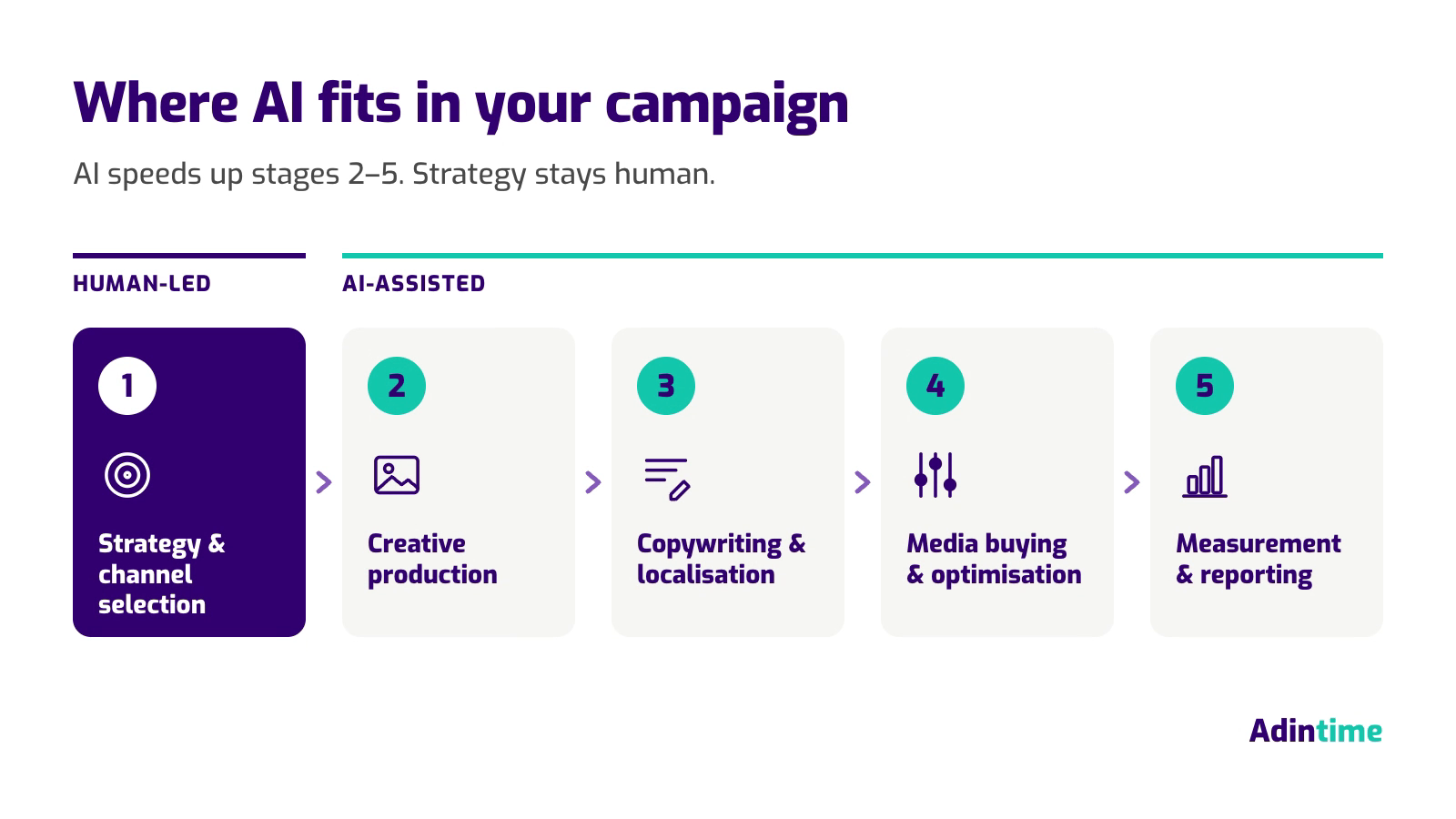
AI tools don’t replace a media plan. They speed up specific stages of it. A typical Hong Kong campaign moves through five stages:
- Strategy and channel selection: who you’re targeting and where they are.
- Creative production: visuals, video, adaptations for each format.
- Copywriting and localisation: English, Traditional Chinese, Cantonese, and sometimes Simplified Chinese for mainland visitors.
- Media buying and optimisation: bidding, budget allocation, pacing.
- Measurement and reporting: what worked, and what to change next time.
AI is strongest in stages 2 to 5. Stage 1 is still a human job that depends on local market knowledge. Our guide to planning a successful advertising campaign walks through it step by step.
Creative generation
Producing high quality visual assets at scale is one of the most resource intensive parts of running campaigns. AI ad generators can cut production time from days to hours, especially when you need dozens of sizes for social feeds, display banners and digital screens.
Leading tools:
- AdCreative.ai, Pencil and Omneky: generate and score ad variations at scale, and are useful for testing several hooks or layouts at once.
- Midjourney, DALL·E and Adobe Firefly: create base images. Firefly is often preferred by brand teams because Adobe positions it as commercially safe.
- Runway and Pika: generate and edit short video, useful for social cut downs and digital out-of-home (DOOH) loops.
- Canva AI: an all in one suite for quick resizing and on brand templates.
Quality control is your responsibility. A hundred mediocre variants are worth less than three strong, culturally relevant concepts. AI generated visuals often miss local cues: street scenes that don’t look like Hong Kong, wrong festive symbolism, or Chinese characters rendered as garbled shapes inside images. You still need an art director with a local eye to curate the outputs.
Large format outdoor creative carries higher stakes. A 3D or anamorphic billboard needs production grade work, not a quick AI render. Adintime’s 3D Billboard Animation Service covers that end of the spectrum. For examples of what works locally, see our round up of the top 10 advertisements in Hong Kong.
Copywriting and localisation
Ad copy, landing pages and email sequences are where generative AI first made its mark.
Leading tools:
- Jasper and Jacquard: marketing specific platforms built around brand voice and conversion copy. Jacquard focuses on subject lines and CRM messaging.
- ChatGPT, Claude and Gemini: general purpose models that work well for drafting high volumes of copy, building briefs, and structuring long form content.
Traditional Chinese output varies widely between platforms, and written Cantonese is weaker still. Common problems include:
- Simplified Chinese vocabulary slipping into Traditional Chinese text
- Stiff phrasing that reads like a direct translation from English
- Formal written Chinese where the brand voice calls for colloquial Cantonese, or the reverse
- Tones and slang that feel off to local audiences
Use AI for ideation and first drafts, and have a native speaker review everything before it goes live. Picking the right language for each audience is a strategic decision in its own right. Our guide on choosing between Cantonese, Mandarin or English for your ads covers when to use each, and how to target mainland Chinese visitors in Hong Kong.
Media buying and optimisation
AI marketing tools shine when crunching performance data: optimising bids, reallocating budget, and pausing underperforming ads in real time.
Leading tools:
- Albert: cross channel autonomous optimisation across search, social and programmatic.
- Madgicx and Smartly: paid social automation, mainly for Meta, with creative and audience insights.
- Adzooma: PPC management and recommendations for Google and Microsoft Ads.
Most of these platforms are built around Meta, Google and global programmatic networks. Their integration with WeChat, Xiaohongshu, local publishers and Hong Kong’s out-of-home inventory is weak or missing entirely. If a large share of your audience sits on those channels, an AI optimiser will only see part of your campaign.
For platform specific costs and setup, see our guides to WeChat advertising in Hong Kong, Xiaohongshu advertising, Facebook ad costs, YouTube advertising costs and LinkedIn advertising costs. If you want automated, data driven buying on outdoor screens, read Programmatic DOOH in Hong Kong: How It Works and What It Costs.
Predictive analytics
Predictive analytics tools go beyond reporting what happened. They use historical data and consumer signals to forecast which creative, audience or channel will perform.
Leading tools:
- Pattern89: predicts creative performance before launch.
- Proxima: audience and performance data for paid social.
- Warmly: intent and signal based analytics, mainly for B2B lead identification.
Treat these forecasts with caution. The models are often trained on global or US centric benchmarks and can miss Hong Kong patterns: mall centred shopping, heavy cross border spending, festive peaks around Chinese New Year and Golden Week, and a market small enough that audience saturation comes quickly. Use the scores as a guide, check them against your own results, and plan around the dates in our Marketing Calendar 2026.
Automation and workflow
Sometimes the most valuable AI tools aren’t the ones making the ads. They’re the ones connecting your systems.
Leading tools:
- Zapier (with AI features) and Gumloop: connect your AI stack, CRM, forms and messaging apps without code.
This is often where marketing teams get the most time back. Common uses include:
- Routing leads from local channels, such as WhatsApp enquiries, into a global CRM
- Auto generating weekly performance summaries
- Triggering creative refreshes when frequency gets too high
If WhatsApp is part of your funnel, see WhatsApp Advertising in Hong Kong: All You Need to Know.
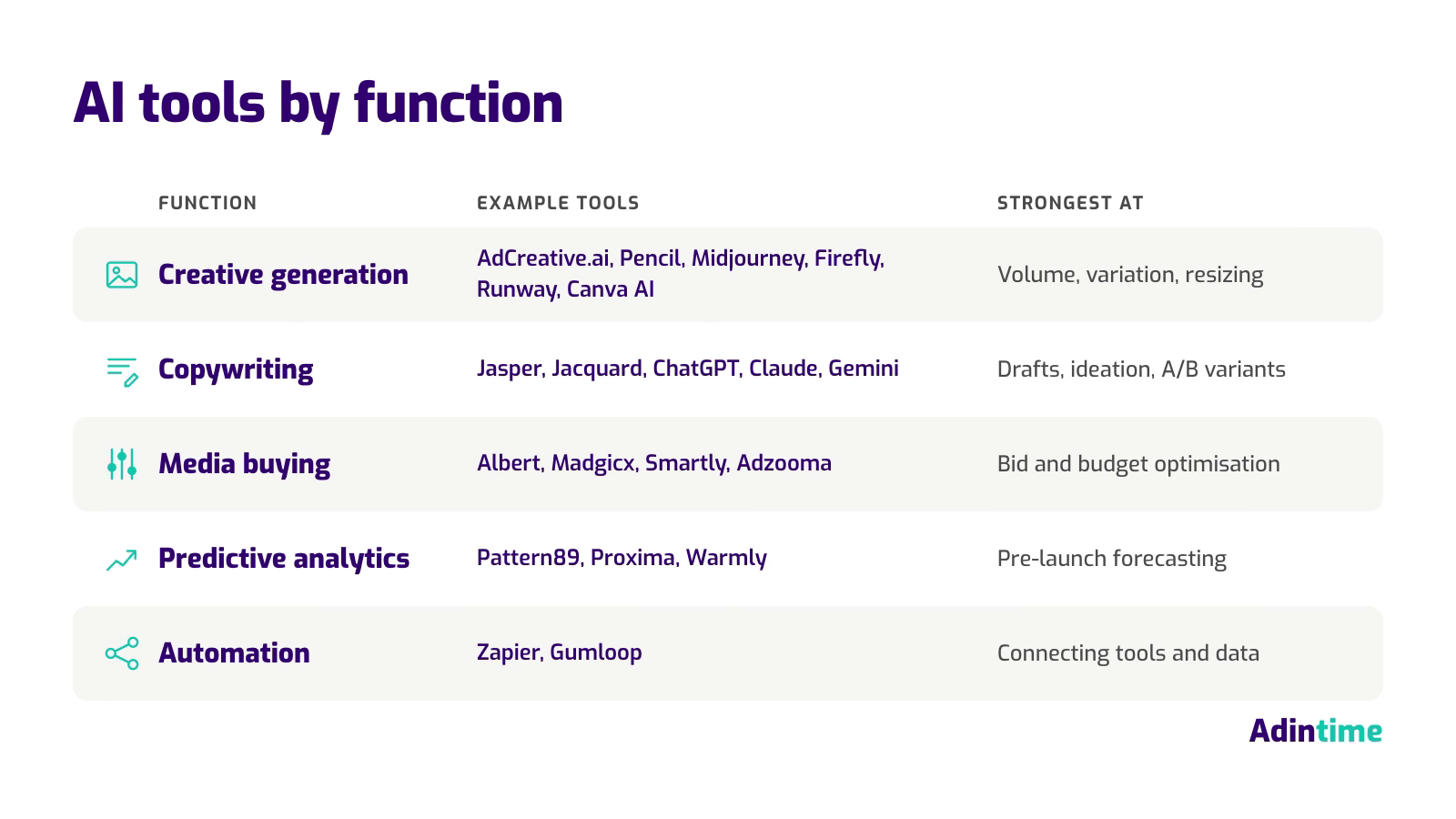
Summary: AI marketing tools by function
Three questions before you buy
Before adding any AI marketing software to your stack, ask:
- Language: can it produce Traditional Chinese and Cantonese to a publishable standard, or only a usable draft?
- Channel coverage: does it support WeChat, Xiaohongshu and local display and DOOH networks, or only Meta and Google?
- Pricing fit: does the pricing model fit a Hong Kong sized budget? Many tools price by seats or by percentage of ad spend, and enterprise tiers can exceed a local campaign budget.
In Hong Kong, the most effective stack is usually a hybrid: global AI tools for creative and copy production, plus local platform knowledge and media buying.
How to build your AI stack
Start with your biggest bottleneck. If design is slowing you down, start with a creative tool. If copy is the problem, start with a writing assistant. Add one tool at a time.
Prove value before you expand. Run a 4–6 week test with a clear metric, such as hours saved, cost per lead or creative output, before renewing or adding another subscription.
Budget for the human layer. Set aside time and money for native language review and art direction. Our advertising budget guide explains how to split spend between production and media.
Ready to run your campaigns across Hong Kong’s most effective channels? Submit a media brief and our team will build a cross channel plan for you, or browse our social media and online display solutions.
FAQ
1. What is the best AI ad tool?
No single tool does everything. The most effective approach is a small stack: an image generator, a copy assistant, an optimiser and an automation tool, chosen around your team’s specific bottlenecks.
2. Do AI marketing tools work well in Traditional Chinese?
English output is strong. Traditional Chinese varies, and written Cantonese is weaker. Most tools produce a usable draft, but a native speaker should review and localise everything before it goes live.
3. Do global AI tools support WeChat and Xiaohongshu?
Mostly not. Most Western AI marketing software integrates with Meta, Google and LinkedIn. To advertise on Chinese social platforms, pair these tools with local media buying.
4. Where should a small Hong Kong brand start with AI tools?
Find your worst bottleneck first, usually creative production or copywriting, and use one tool to solve that problem. Measure the result before adding more.
5. Will AI advertising tools replace my team or agency?
No. These tools give your team leverage. They still need strategy, cultural judgement and local media knowledge to deliver ROI. That’s why many brands pair them with an advertising agency in Hong Kong for planning and buying.
6. How much do AI marketing tools cost in Hong Kong?
Prices range from low cost monthly subscriptions to enterprise contracts. Check whether the pricing model, often based on user seats or a percentage of ad spend, fits your budget, and start with a monthly plan or free trial.
7. Can AI help with outdoor and DOOH advertising?
Yes, mainly in creative production and in programmatic DOOH buying, where screens can be bought with data driven triggers. Booking traditional outdoor sites still relies on local media access. Read OOH/DOOH Advertising in Hong Kong: Formats and Rates to learn more.
 Launching a Brand in Hong Kong: A First-Year Media Playbook
 Best AI Advertising Tools for Marketers in Hong Kong (2026)
 How to Advertise to Mainland Chinese Visitors in Hong Kong
 Shopping Mall Advertising in Hong Kong: Formats, Footfall and Rates
 WeChat Advertising in Hong Kong: Formats, Costs and How to Set It Up
 Understanding YouTube Advertising Costs in 2025
 The Most Widely-Read Magazine and Newspaper in Hong Kong
 Top Social Media Platforms in Hong Kong 2025 | Usage Trends & Marketing Insights
 OOH /DOOH advertising in Hong Kong: Formats and Rates (2025 Update)
 How much does LinkedIn Advertising Cost? (2025 Update)
