 Cookie preferences


Launching a Brand in Hong Kong: A First-Year Media Playbook
Want to save time?
Summarize this article in seconds with AI
When overseas brands work out how to launch in Hong Kong, the most common mistake is running their Singapore or UK marketing plan unchanged. In many Western markets, a new brand can launch through digital performance media alone, quietly building a customer base before investing in physical brand awareness. In Hong Kong, that approach usually leads to flat growth and rising acquisition costs.
A new brand in Hong Kong needs a different playbook. This guide covers what makes the market different, the decisions to make before spending anything, a quarter by-quarter plan for year one, three worked budgets, and the mistakes that cost the most.
Already have a launch date? Submit a media brief and our team will build a plan around it.
What makes Hong Kong different
To enter this market, you first need to understand how consumer trust is built here. For the wider context, start with our overview of Hong Kong’s advertising market. Overseas brands consistently underestimate five things.
1. Physical visibility is a trust signal. Hong Kong consumers link physical advertising with brand legitimacy. If they haven’t seen you on a billboard, a bus or in the MTR, many will assume you’re a dropshipper, or too small to matter. Outdoor advertising here works less as awareness and more as proof that you’re a real business.
2. Retail life is centred on malls. The climate and the density of the city make air conditioned shopping malls the centre of social and retail life. E-commerce keeps growing, but many purchase decisions still happen in physical retail or are shaped by it. Our guide to shopping mall advertising in Hong Kong breaks down the formats and footfall.
3. Traditional Chinese and Cantonese are essential. Close to nine in ten residents speak Cantonese at home, and they read Traditional Chinese, not Simplified. Simplified Chinese, or a stiff translation from English, signals that the brand isn’t really for them. Our guide on choosing between Cantonese, Mandarin or English explains when each language works.
4. In a small market, frequency matters more than reach. Hong Kong is compact, and most people travel similar routes on the MTR and buses. That means you can build high repetition quickly and at a reasonable cost. Being seen five times in a week by the same commuter usually beats being seen once by everyone.
5. The outdoor network is dense. Compared with other major global cities, out-of-home advertising in Hong Kong is often more affordable than brands expect, and its high impact formats line daily commutes. See our Hong Kong outdoor advertising cost report for current price levels.
Before you spend anything: three decisions
Before you build the media plan, make three foundational decisions.
1. Position the brand in Cantonese, not translated English. Your core messaging should be transcreated, not just translated, into natural Cantonese and Traditional Chinese. That means adapting the idea, the humour and the cultural references, not only the words. Direct translations from English often sound stiff or miss the nuance needed to connect. Budget for a local copywriter from the start.
2. Decide which audience you’re actually buying. Hong Kong has three very different audiences, and each needs a different media mix:
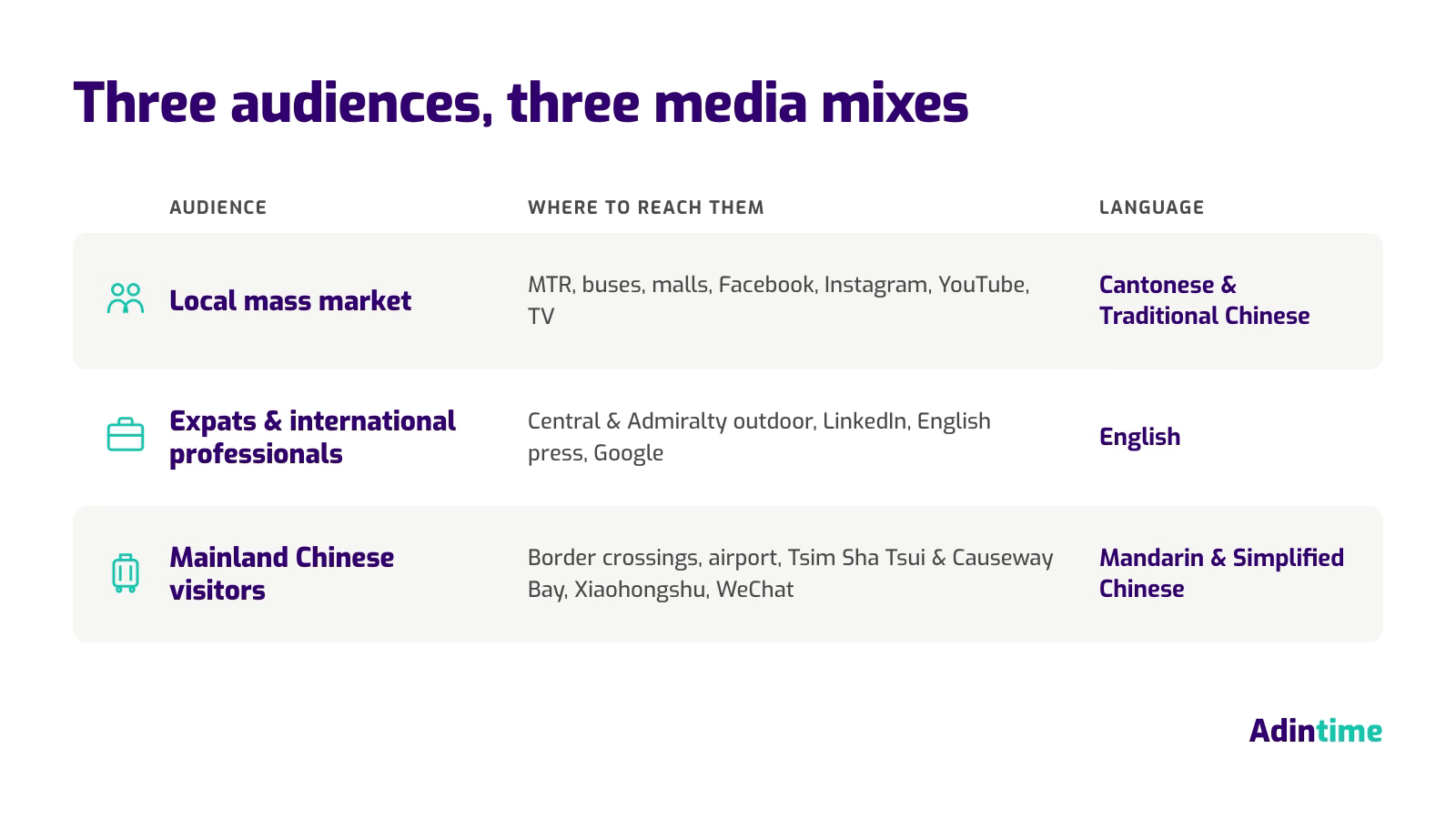
If mainland visitors are your target, read How to Advertise to Mainland Chinese Visitors in Hong Kong before booking anything.
3. Set up distribution before you drive demand. Is your inventory, logistics, retail presence or e-commerce checkout ready? Don’t spend heavily on demand if consumers can’t buy the product as soon as they see it. Outdoor advertising that sends people to a store that doesn’t stock you yet wastes budget and damages trust.
It’s also worth checking local rules before you produce creative. Product categories such as health claims, alcohol and financial services have specific restrictions.
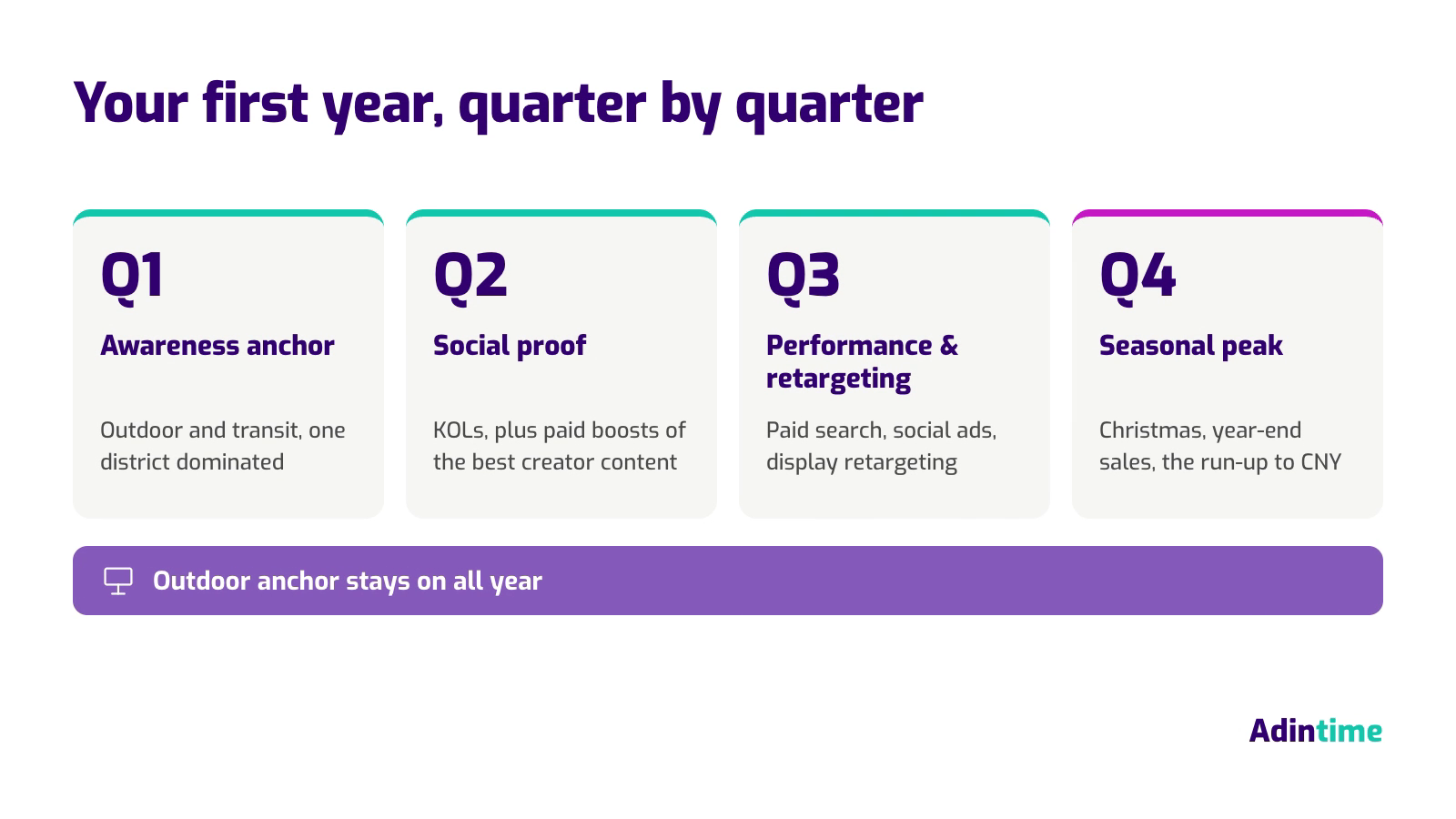
Q1: the awareness anchor
Your first quarter is about buying credibility fast. In Hong Kong, the most effective way to do that is an out-of-home or transit anchor.
What does “enough” look like? One district done properly beats a city wide campaign spread too thin. Choose one high footfall area, such as Causeway Bay, Mong Kok or Tsim Sha Tsui, that matches your audience, and dominate it. Concentrated presence makes a new brand feel like it’s everywhere.
Formats to consider:
- MTR advertising: station dominations, concourse digital panels and lightboxes in a key interchange station. These deliver the highest daily frequency.
- Bus shelters and bus and tram advertising: street level visibility that follows your audience’s daily routes.
- Digital out-of-home (DOOH): flexible scheduling and fast creative changes, and you can buy it programmatically. See Programmatic DOOH in Hong Kong.
- Large format LED and 3D billboards: for brands that want a statement launch.
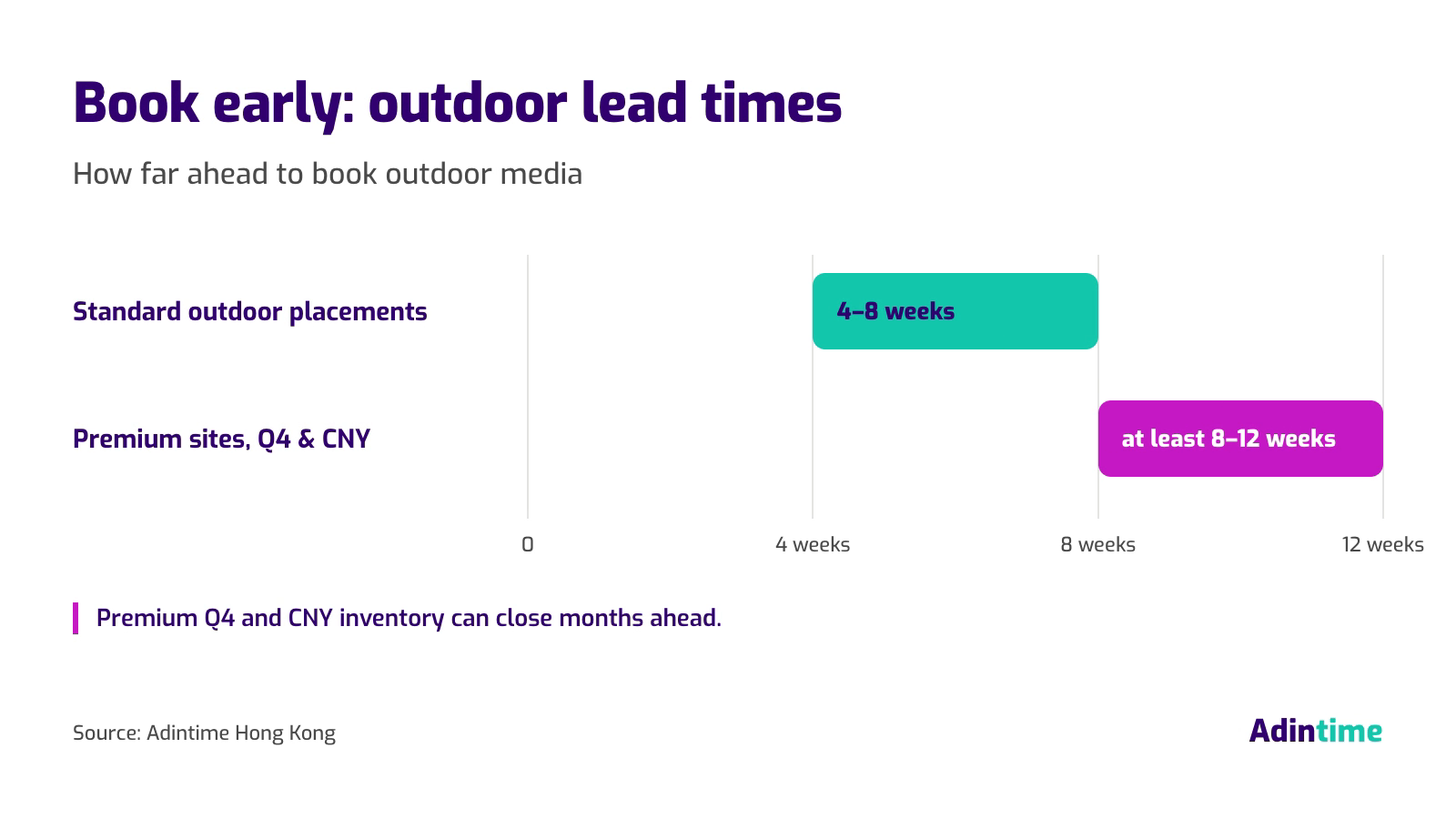
Lead times: standard outdoor placements usually need booking 4 to 8 weeks ahead. Premium sites and peak periods need longer (see Q4).
Set up measurement now. Install website analytics, conversion pixels and a branded search baseline before the first poster goes up. You’ll need that “month zero” data to prove the anchor is working.
Q2: social proof and the KOL layer
Once the awareness anchor is live, Q2 is about adding social proof. As our guide to influencer marketing: how to succeed explains, success depends heavily on which audience you choose.
- Local KOLs (key opinion leaders) mainly work on Instagram, Facebook and YouTube. Check our ranking of the top social media platforms in Hong Kong for current usage.
- Mainland facing KOLs dominate Xiaohongshu and WeChat.
Balance micro influencers, for engagement and niche trust, with macro influencers, for broad reach. When briefing creators, put authenticity ahead of strict brand guidelines. Hong Kong consumers quickly spot over scripted endorsements.
Boost the best performing creator content with paid social media advertising. This extends its reach well beyond the creator’s organic audience.
Q3: performance and retargeting
By Q3, your awareness base should be turning into search demand and consideration. Now is the time to shift budget towards performance and retargeting to capture conversions. That includes:
- Paid search (SEM) on branded and category terms
- Social performance ads. See our breakdown of Facebook ad costs for benchmarks.
- Dynamic retargeting of site visitors through online display advertising and programmatic channels
This only works if you installed tracking in Q1. Understanding how buying works across programmatic and digital channels will determine how efficient your CPA (cost per acquisition) is.
Keep the outdoor anchor running in the background, even at a reduced weight. It’s what makes the performance media cheaper.
Q4: the seasonal peak
The fourth quarter is driven by major retail moments: Christmas, year end sales and the run up to Chinese New Year (CNY).
These are the most competitive periods of the year. Booking windows for premium inventory can close months ahead, so whether you get visibility at all depends on how early you plan. Book premium outdoor and transit placements at least 8 to 12 weeks in advance, and line up your Q4 push with the Hong Kong seasonal calendar in our Marketing Calendar 2026. Otherwise you’ll be competing for leftover inventory.
What to measure in year one
Knowing the campaign planning process means knowing which metrics matter. In your first four months, track these leading indicators:
Aided and unaided awareness: are target consumers starting to recognise your brand name, with and without a prompt? Short survey panels can track this each quarter.
Branded search volume: are more people searching for your brand after the outdoor campaign goes live? Compare against your month zero baseline.
Footfall or site traffic: is baseline traffic higher than in month zero, including on weeks without promotions?
Cost per acquisition trend: is CPA on performance channels falling as awareness builds?
If these indicators are still flat by month four, adjust your creative or channel mix straight away. Unfamiliar terms are explained in our advertising glossary.
Five mistakes that cost the most
- Running English only creative. It shuts out most of the local mass market, who read Traditional Chinese and speak Cantonese.
- Spreading outdoor too thin. One panel in each of five stations makes almost no impact. Concentrate instead.
- Launching in the wrong district. Putting a mass market product in a luxury district, or the reverse, wastes spend on the wrong audience.
- Booking peak inventory too late. Waiting until November to plan means missing the Q4 and CNY windows.
- Cutting the awareness anchor too early. Pulling outdoor budget in month two because performance looks flat stops the credibility before it has time to build.
Submit a media brief and our team will put together a first year plan for your budget, or work with our advertising agency in Hong Kong.
FAQ
1. Should I start with outdoor advertising or digital?
In Hong Kong, start with outdoor. Physical visibility is a key trust signal, and consumers often want to see it before they’ll convert on digital channels. Set up digital tracking at the same time so you can measure the uplift.
2. Do I need Cantonese creative from day one?
Yes. Unless your product targets only expats, Traditional Chinese and natural Cantonese phrasing are essential for mass market acceptance. Read Cantonese, Mandarin or English: Choosing Your Ad Language in Hong Kong.
3. Which district should a new brand advertise in first?
It depends on your audience. Causeway Bay, Mong Kok and Tsim Sha Tsui are the three main high footfall retail districts. Central suits business and premium audiences. Pick one and dominate it rather than spreading your budget across all of them.
4. How far before a launch should I book media?
Book standard outdoor placements 4 to 8 weeks ahead. For premium outdoor and transit placements, especially in Q4 or before Chinese New Year, book at least 8 to 12 weeks in advance.
5. How do I know if the first year worked?
Look at branded search volume, aided awareness, and baseline footfall or site traffic. If your baseline has risen and stayed up, and your CPA is stable or falling, the foundation is in place.






 Launching a Brand in Hong Kong: A First-Year Media Playbook
 Best AI Advertising Tools for Marketers in Hong Kong (2026)
 How to Advertise to Mainland Chinese Visitors in Hong Kong
 Shopping Mall Advertising in Hong Kong: Formats, Footfall and Rates
 WeChat Advertising in Hong Kong: Formats, Costs and How to Set It Up
 Understanding YouTube Advertising Costs in 2025
 The Most Widely-Read Magazine and Newspaper in Hong Kong
 Top Social Media Platforms in Hong Kong 2025 | Usage Trends & Marketing Insights
 OOH /DOOH advertising in Hong Kong: Formats and Rates (2025 Update)
 How much does LinkedIn Advertising Cost? (2025 Update)
