 Cookie preferences


What's the price of an outdoor campaign in Hong Kong in 2026?
Are you planning an outdoor campaign in Hong Kong for 2026? Stop guessing your 2026 Hong Kong OOH budget! If you are looking to make a splash in this densely populated metropolis, the first step is to understand the actual Out-of-Home (OOH) advertising cost of Hong Kong. Whether you want to dominate the facades of Causeway Bay or strategically target daily commuters on the transport network, understanding the "why" behind the price tag is the first step toward maximizing your Return on Ad Spend (ROAS).
According to our data in 2025, while a broad city-wide campaign averages HK$95,000, a highly targeted local campaigns offer accessible entry points averaging just HK$47k. The pricing depends on media formats, location, duration and size. The actual rates can differ because of several variables, contact our experts to get customized quote!
See our OOH costs infographic
Key takeaways for 2026
- The baseline average: According to our expansive 2025 study across all titles, periods, formats, and cities, the average cost of an advertising campaign is HK$115k. Furthermore, an Adintime barometer looking at all OOH media combined revealed an incredibly accessible average of HK$92k.
- The DOOH Format: Digital Out-of-Home is redefining entry costs. Campaigns on DOOH networks average just HK$51k. This cost-efficiency is heavily driven by programmatic buying, allowing brands to purchase shorter slots rather than the standard 4 weeks campaign duration.
- Premium transit assets: Taking over the streets with Taxi advertising commands the highest average media cost at HK$325K, offering massive mobile visibility. In contrast, Bus and Minibus campaigns average a highly efficient HK$72K.
- Location dictates price: Premium retail hubs like Causeway Bay command the highest average local campaign cost at HK$79k, while budget-friendly, high density residential neighborhoods like Cheung Sha Wan offer strategic entry points for as little as HK$4k.
- Industry spending leaders: The Pharmaceutical industry leads the market by a massive margin, with an average campaign size of HK$600k. Fitness follows at HK$472k, and Finance/ Insurance rounds out the top three at HK$119k.
The Hong Kong OOH market in 2026
Before we dive into the specific rate cards and formatting costs, it is crucial to understand the macroeconomic forces shaping the OOH advertising cost Hong Kong in 2026.
The market has fully transitioned into a new era of digital maturity. According to recent 2026 projections from Mordor Intelligence, the Hong Kong OOH and DOOH advertising market is estimated to reach an impressive USD 670.94 million (up from USD 635.05 million in 2025), growing at a robust CAGR of 5.65%.
Especially for DOOH, there’re two massive drivers are at play:
- Flexibility of operation: DOOH screens are shared among multiple advertisers and are typically bought on a Cost Per Mille (CPM), or cost per thousand impressions basis. Instead of renting the panels for a standard monthly package, you are welcome to purchase the best durations for your target demographic. Ultimately, traditional OOH locks in a physical location for a set time, while DOOH offers the flexibility to optimize budgets around actual audience impressions.
- The programmatic DOOH leap: DOOH now commands nearly 58% of total market spend. Real time creative control, weather triggered dynamic ads, and programmatic buying layers have transformed how we buy space, bringing the barrier to entry down while improving targeting precision.
These factors perfectly contextualize our barometer data. While massive global brands might skew the broader market, our Adintime findings demonstrate that strategic, data driven buying can keep the all media combined average campaign cost at a sensible HK$92k.
Hong Kong OOH advertising costs by format: 2025 – 2026 benchmarks
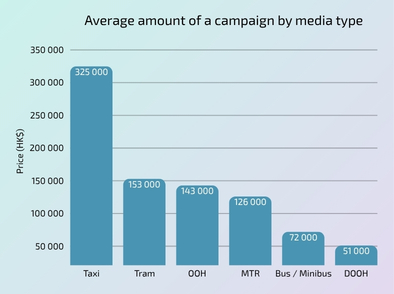
In Hong Kong, the medium is the message, and the format you choose will dictate the share of your budget. Let’s break down the average campaign amounts by media type based on our extensive internal barometer.
1. Taxi & tram advertising: mobile dominance
- Taxi average campaign cost: HK$325K
- Tram average campaign cost: HK$153K
Taxis offer blanket coverage of the city, penetrating areas where massive billboards are restricted. An investment of HK$325K generally reflects wrapping a substantial fleet of vehicles to ensure high frequency across New Territories, Kowloon and Hong Kong Island. Conversely, Tram advertising averages HK$153K. The Hong Kong Tramways traverse the absolute wealthiest commercial districts in Hong Kong Island. Because they move slowly, the pedestrian dwell time to view your ad is incredibly high, offering a premium "moving billboard" effect at half the cost of a massive taxi fleet wrap.
Learn more: Find the information on our taxi advertising page & tram advertising page.
2. Traditional OOH (Static) vs. DOOH (Digital)
- Static OOH average campaign cost: HK$143k
- DOOH average campaign cost: HK$51k
You might expect digital to cost more, but the reality of 2026 is that DOOH offers unparalleled budget flexibility. Because DOOH screens (averaging HK$51k) operate on a shared loop (typically a 10 to 15 seconds spot and more than 12 times per hour) and utilize programmatic bidding, you are only paying for a fraction of the screen's time. This makes it an incredibly cost-effective entry point. Traditional Static OOH (averaging HK$143k) demands a higher premium because you are purchasing 100% Share of Voice (SOV). The space is yours 24/7, requiring physical printing and installation, which drives up the baseline commitment.
Learn more: Explore the digital specifications and capabilities on our OOH advertising page & DOOH advertising page.
3. MTR advertising: the captive audience
- Average campaign cost: HK$126k
The Mass Transit Railway (MTR) is the lifeblood of Hong Kong, carrying millions of passengers daily. At an average of HK$126k, an MTR campaign strikes a perfect balance between reach and cost. You can either buy a bundle package covering numerous station lines at a more competitive rate, or pick the lightbox in a targeted specific station to reach the most suitable audiences.
Learn more: Discover zone-specific rate cards on our MTR advertising page.
4. Bus & minibus advertising: the tactical commuter choice
- Average campaign cost: HK$72K
Bus and Minibus formats are the affordable ways of street-level reach, averaging HK$72K. While double-deckers offer massive formats across major routes over the city, minibuses allow for local penetration into steep, residential, or narrow neighborhoods where larger vehicles and billboards cannot go. This makes them highly effective for localized retail pushes or community messaging.
Learn more: Dive into route planning and demographics on our Bus advertising page & Minibus advertising page.
Media format comparison
| Media type | 2025 average campaign cost | Primary advantage | Share of voice / strategy |
|---|---|---|---|
| TAXI | HK$325K | Unrestricted city-wide geographic reach | High Frequency Fleet |
| TRAM | HK$153K | High dwell time in premium commercial districts | Iconic Cultural Integration |
| OOH (Static) | HK$143k | Permanent presence, high brand authority | 100% Ownership (24/7) |
| MTR | HK$126k | Captive commuter audience, mass daily reach | Strategic Station Selection/ bundle package available |
| BUS / MINIBUS | HK$72K | Broad mass transit reach, micro-targeting | Moving Impact at street-level |
| DOOH | HK$51k | Real-time flexibility, programmatic efficiency | Shared Loop (Time-based) |
Advertising location: district pricing demystified
If you aren't ready to deploy a massive city wide network buy, you can reach your targeted audiences accurately by localized district campaigns. According to our barometer, the average amount of a local advertising campaign at Adintime is highly efficient at HK$47k. The cost to advertise in a luxury shopping district differs vastly from a rising residential hub in Kowloon. Let's look at the two extremes.
The premium hubs: top 3 highest average costs
When targeting high-net-worth individuals, heavy foot traffic, and eager consumers, these are the popular districts:
%20V2%20Location%20Top%203%20highest.jpg)
| Rank | District | Average local campaign cost | Why it's premium |
|---|---|---|---|
| 1 | Causeway Bay | HK$79k | The undisputed retail capital of HK. Massive pedestrian crossings with extremely high luxury concentration. |
| 2 | Mongkok | HK$49k | The most densely populated district among Teens. Ground zero for youth culture, electronics, cosmetics, and streetwear. |
| 3 | Kai Tak | HK$30k | As a rising star develops alongside luxury residences and the new mega sports park, CPMs here are surging rapidly. |
For bespoke strategies in these premium areas, visit our Specific District pages.
The budget-friendly zones: top 3 lowest average costs
For localized services or community messaging, or brands prioritizing frequency over prestige, Kowloon's neighborhoods offer incredible value:
%20V2%20Location%20Top%203%20lowest.jpg)
| Rank | District | Average local campaign cost | Strategic value |
|---|---|---|---|
| 1 | Cheung Sha Wan | HK$4k | Historically industrial, now a booming hub for creative agencies, SMEs, and young professionals requiring hyper-targeted B2B media. |
| 2 | Prince Edward | HK$6k | High local foot traffic, characterized by major cross-border transit links and dense residential clusters. |
| 3 | Lai Chi Kok | HK$11k | Dense office worker population. Perfect for B2B tech, corporate lunch-hour targeting, and recruitment campaigns. |
Which industries are spending the most on advertisements?
When you buy OOH in Hong Kong, who are you competing against for premium space? Our expansive study of advertising campaigns conducted from January 2025 to December 2025 across all titles, periods, formats, and cities revealed a distinct hierarchy of heavy spenders.
The top 3 industries driving massive OOH investment are:
.png)
- Pharmaceutical: Dominating the charts, this sector averages a staggering HK$600k per campaign. With Hong Kong's aging population and a renewed post-pandemic focus on health supplements and wellness, pharmaceutical giants are aggressively buying up prime transit and street-level inventory to secure top-of-mind awareness.
- Fitness: Coming in second with an average campaign size of HK$472k. The explosion of boutique gyms, 24/7 fitness franchises, and wellness tech in Hong Kong requires highly visual, motivational ad placements, which often leverage DOOH near commercial office districts and major MTR exits.
- Finance / insurance: A cornerstone of the Hong Kong economy, this sector averages HK$119k per campaign. Retail banks, wealth management firms, and insurance providers utilize a mix of trusted OOH and localized transit buys to build long-term brand equity and trust.
How are OOH prices calculated in Hong Kong?
A common question entering the market is: "Why is there a difference between the published rate card and what I actually pay?"
Understanding the hidden mechanics of the OOH advertising cost Hong Kong is essential for effective negotiation and budgeting.
1. Gross rate cards vs. net agency costs
Major media vendors publish "Rate Cards," which act as the sticker price. However, industry trackers and agencies rarely deal in gross figures. It is standard practice in the Hong Kong market to calculate actual ad spend factoring in severe discount models, which often assume around 15% off the published rate card depending on the season and inventory availability. Through bulk buying, agencies like Adintime secure "Net Rates", which is precisely why our blended all media combined average of HK$92k looks so much more attractive than booking directly.
2. Media space vs. production costs
When analyzing the HK$143k average for static OOH, you must remember that this figure usually comprises two distinct elements:
- Media rental: The cost to lease the physical space for the duration of the campaign.
- Production & installation: The cost to print massive PVC banners, mount them on scaffolding, and ultimately dismantle them. Production in Hong Kong can be incredibly expensive due to strict safety regulations and mandatory nighttime installation requirements, especially in MTR stations or on busy roads.
3. The shift to programmatic DOOH
For DOOH, the pricing model has fundamentally shifted. Programmatic platforms allow advertisers to bid on digital screens in real-time using a CPM (Cost Per Mille / thousand impressions) model, you are only paying for a fraction of the screen's time and you can choose to display your outdoor ad even during extreme weather. The incredible efficiency explains why the DOOH average sits so low at HK$51k, you only pay for the precise moments your audience is watching.
Strategic recommendations for your 2026 campaign
To maximize your budget in 2026, we advocate for a hybrid, data-first approach.
Do not exhaust your entire budget on a single, massive static board unless you are aiming for a grand visual for fans to check in only. Instead, utilize the high impact permanence of a targeted static asset in a district relevant to your audience, such as a buying panels as a part of a network package offers a massive coverage in the city, and support it with a flexible, programmatic DOOH overlay to drive specific calls to action.
Furthermore, leverage the extreme cost efficiency of local campaigns. If your target audience works in specific industrial-turned-commercial zones, an HK$11k local campaign in Lai Chi Kok will yield a substantially higher ROI than fighting for noise in a premium tier-1 hub.
For a complete visual breakdown of these metrics and to see exactly where you stand, please refer back to our comprehensive The 2025 Cost Infographic.
Final thoughts: Ready to start your OOH campaign?
The Hong Kong OOH landscape is dynamic, visually spectacular, and highly competitive. But armed with accurate data, it doesn't have to be intimidating. By understanding the nuanced pricing between different media formats, you can engineer a campaign that aligns perfectly with your KPIs.
Don't navigate the market blindly. Partner with experts who understand where every advertising dollar goes.
Contact our HK experts today to get a custom quote within 48 hours
Frequently Asked Questions (FAQ)
1. Why is digital OOH (DOOH) more affordable than static OOH?
While physical billboard screens are expensive, DOOH campaigns average a highly accessible price because advertisers buy a "share" of the screen time (e.g., buying 10% Share of voice can be converted as 360 secs per hour) rather than paying for 100% exclusivity 24/7. Additionally, DOOH eliminates the hefty physical printing and installation costs associated with static boards.
2. What is the most cost effective district for a local campaign?
According to our data, Cheung Sha Wan offers the lowest barrier to entry with an average local campaign cost of just HK$4k compared with nearby areas such as Sham Shui Po for HK$31k and Mongkok for HK$49k. This makes it an excellent testing ground for hyper-local businesses and B2B services looking to avoid the premium costs associated with CBD districts like Causeway Bay.
3. Does the HK$115k average campaign cost include production?
The HK$115k average derived from our comprehensive study generally reflects total campaign spend, which blends media rental with production costs. However, physical formats (like Taxis or Static OOH) will have a much higher ratio of production and installation costs compared to DOOH, where production is largely just digital asset creation.
4. How much does a comprehensive transit campaign cost?
It depends heavily on the vehicle. Wrapping a large fleet of Taxis commands the highest average at HK$325K due to massive, unrestricted city coverage. In contrast, Bus/ Minibus campaigns are highly efficient at HK$72K, and MTR campaigns average HK$126k, allowing brands to target distinct commuter routes without blowing the budget.
5. Do I really have to pay the "Rate Card" prices?
Rarely. The Hong Kong market operates on heavily discounted net rates. When you see our Adintime all media combined average sitting at HK$92k, it is because specialized agencies secure volume discounts, and sometimes up to 30% off the gross rate card passing those efficiencies down to the advertiser.
%2520Media%2520Type.jpg)
%2520Industry%2520copy.jpeg)




 How to Advertise to Mainland Chinese Visitors in Hong Kong
 Shopping Mall Advertising in Hong Kong: Formats, Footfall and Rates
 WeChat Advertising in Hong Kong: Formats, Costs and How to Set It Up
 Programmatic DOOH in Hong Kong: How It Works and What It Costs
 Cantonese, Mandarin or English: Choosing Your Ad Language in Hong Kong
 Understanding YouTube Advertising Costs in 2025
 The Most Widely-Read Magazine and Newspaper in Hong Kong
 Top Social Media Platforms in Hong Kong 2025 | Usage Trends & Marketing Insights
 OOH /DOOH advertising in Hong Kong: Formats and Rates (2025 Update)
 How much does LinkedIn Advertising Cost? (2025 Update)
