 Cookie preferences


MTR advertising vs bus advertising: which fits your brand?
Want to save time?
Summarize this article in seconds with AI
目錄
- 受眾契合度:各媒介觸及的對象
- 品牌行業:各媒介的優勢領域
- 推廣目標:將廣告媒介與你的目標匹配
- 創意要求:各媒介對設計的要求
- 港鐵:2026 年的精準定位
- 巴士路綫定位:地理邏輯
- 兩種媒介的理據:客觀評估
- 何時適合雙管齊下
- 哪種廣告形式最適合您的品牌?
- 快速決策指南
- 常見問題
受眾契合度:各媒介觸及的對象
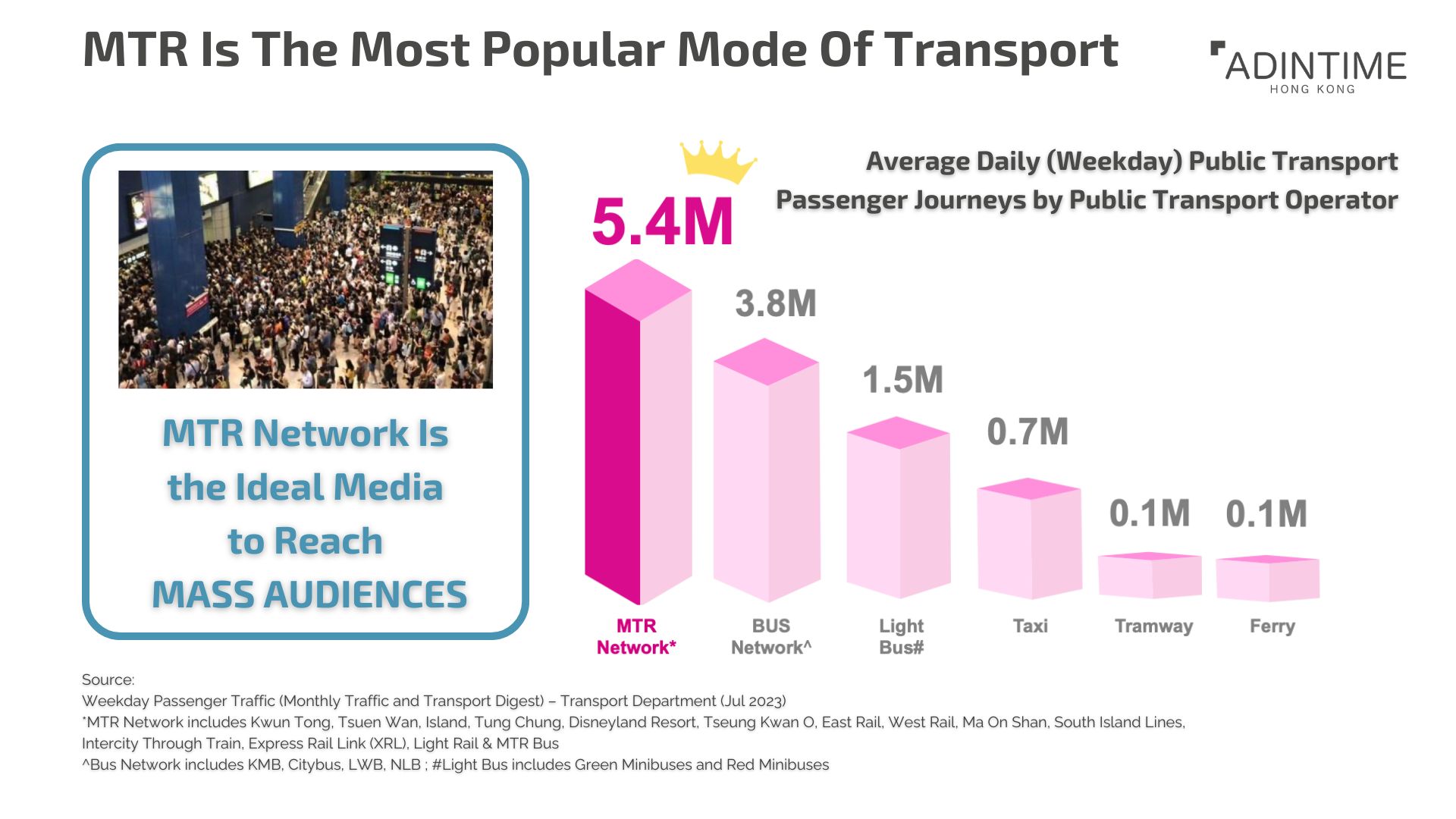
港鐵涵蓋 100 多個車站,每日載客量達 490 萬人次。其受眾特徵有著清晰的數據支持:39% 的港鐵乘客擁有大學學位,主要偏向受過教育的城市專業人士,這群人在繁忙時段主導了中環、金鐘、尖沙咀和銅鑼灣等車站。
巴士廣告每天觸及 390 萬名乘客,加上在街道上看到巴士車身廣告的無數行人與司機。其人口統計特徵更廣泛,更能代表全香港的人口結構:包括九龍東和新界的基層市民、住宅區的家庭,以及各收入階層的街邊購物者。
客觀地說:如果你的目標受眾是集中在城市商業核心的香港中產專業人士及以上階層,港鐵在該受眾群體中的觸及率遠超其他戶外媒介。如果你的受眾是涵蓋各年齡層、收入水平和地區的廣大香港市民,巴士的覆蓋面則更為全面。
Brand sectors: where each format excels
MTR is the natural fit for:
%20(10).jpg)
Financial services and banking. Central and Admiralty stations serve the densest concentration of finance professionals outside of a dedicated business park. The MTR advertising audience insight data shows strong over indexing on high income earners in these station clusters.
Property developers. MTR line specific targeting allows property advertisers to reach audiences along the exact corridors where new developments are sited, Tuen Ma Line for New Territories projects, East Rail Line for cross border audiences, Island Line for Hong Kong Island residential launches. Station takeovers near show flat locations are standard in property launch campaigns.
Luxury and premium brands. The MTR's captive, upmarket skewing audience and controlled indoor environment make it one of the few OOH formats where luxury creative reads as premium rather than incongruous.
Technology and app launches. Younger, educated, smartphone first audiences over index on the MTR. For app launches, fintech products, e-commerce platforms and tech accessories, the MTR delivers the right demographic at scale. QR codes on MTR lightboxes work, the audience has their phone out and the dwell time to scan.
Bus is the natural fit for:
%20(9).jpg)
FMCG and everyday consumer brands. For products that everybody buys, beverages, snacks, household products, personal care, the MTR's professional skew is actually a limitation. Bus reaches the full socioeconomic range of Hong Kong consumers, including the mass market segments that FMCG brands need at scale.
F&B chains and restaurants. Bus body advertising creates appetite level awareness at street level, seeing a food brand on a passing bus near the lunchtime strip is contextually relevant in a way that an underground MTR concourse is not. Route targeting allows F&B brands to concentrate on the districts where they operate.
Entertainment and events. Film releases, concerts, theme park campaigns and sports events benefit from the visual spectacle of a fully wrapped Super Whole Bus. A branded bus on Nathan Road or Hennessy Road during the week before a major event is both a media placement and a public event in itself.
Local and regional retail. A retail chain opening a new store in Kowloon East can target bus routes serving that district specifically, reaching residents who live within the store's catchment area repeatedly. The MTR's station based geography rarely matches retail catchment areas as precisely as bus route targeting does.
Campaign objective: matching the format to your goal
Brand awareness at city scale
MTR concentration approach: a full station takeover creates a concentrated awareness moment, everyone who passes through that station in a week sees your brand dominating the environment. Bus frequency approach: wraps across ten routes create distributed city scale awareness, your brand is present across many districts simultaneously, building frequency through repeated exposure.
The MTR concentration approach works better for launches that need to create an immediate conversation moment. The bus frequency approach works better for brand building that benefits from repeated exposure across different contexts.
Product launch
MTR's full station takeover is the closest thing Hong Kong OOH has to a "launch event." The Digital Escalator Crown Bank, with its immersive tunnel of screens around escalator runs, is particularly effective for new product reveals. MTR advertising formats on Adintime HK include these high impact options for launch moments.
Bus is better for launches where you need to demonstrate presence across many neighbourhoods simultaneously, a sense of "everywhere" rather than "dominant at one location."
Local activation and retail support
Bus wins for local activation. If you are opening a new location or running a district specific promotion, bus routes serving that area create concentrated local presence that station based MTR advertising cannot replicate as precisely. Bus advertising on Adintime HK includes route level filtering to identify the right services for your target district.
Direct response and conversion
MTR's higher dwell time makes it more effective for direct response mechanics, QR codes, promotional codes, website URLs, app download prompts. Bus interior advertising (seatbacks, ceiling panels) restores dwell time and suits response oriented creative. Bus exterior at street level gives pedestrians 3–7 seconds of visibility, not enough for complex response mechanics.
Creative requirements: what each format demands
The MTR's indoor, controlled lighting environment rewards detailed creative. You can use finer typography, a more complex layout, longer copy, QR codes and nuanced imagery. Digital formats on the MTR (Motion Zone, Digital Escalator Crown, In Train TV) support video and motion graphics, a significant creative advantage for brands with video assets.
Bus exterior creative has to work in 3–7 seconds at street level, in variable weather and lighting, from a passing angle. The most effective bus body ads are simple: one strong image, one clear message, a legible brand logo at distance. Campaigns that try to communicate too much detail on a bus wrap tend to underperform, the message does not land in the time available.
Bus interior advertising (seatback cards, overhead panels, ceiling wraps) is different. Passengers on a 15–30 minute bus journey are in a similar dwell time environment to MTR commuters. Interior bus creative can be more detailed, more conversational and more response oriented.
For most mass market campaigns on either format, bilingual creative (English + Traditional Chinese) is the standard rather than the exception.
MTR: precision targeting in 2026
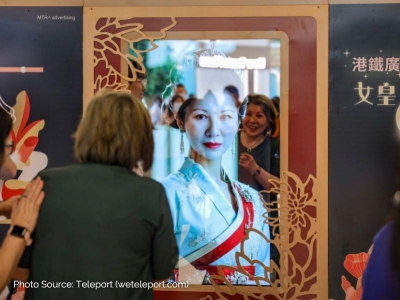
MTR advertising's strengths are real: captive audience, high dwell time, premium demographic skew, strong digital format options, and now precision persona targeting. Its limitations are also real: higher entry cost, station based geography that does not always match campaign targets, and zero pedestrian visibility (the entire audience is underground).
The MTR's traditional weakness versus bus, less geographic flexibility, less audience specificity, is being addressed at the format level. If your brand has a clear audience persona, MTR's new targeting capability is worth evaluating as part of 2026 and 2027 media planning.
Bus route targeting: the geographic logic
_Citybus.jpg)
Bus advertising's most underused capability is route level targeting. Hong Kong's 400+ bus routes are not generic city coverage, each route serves a specific corridor with a specific audience profile. Cross harbour routes connect audiences between Kowloon and Hong Kong Island in a way that no MTR line exactly replicates. New Territories routes serve residential catchments that the urban MTR lines do not touch.
For advertisers with a clear geographic objective, a brand targeting Kowloon East residents, a retailer activating around a specific shopping corridor, a financial institution advertising near its branch network, bus route selection allows geographic specificity that station level MTR buying rarely matches.
Bus shelter advertising adds a fixed location layer: repeated exposure to the same local audience who uses the same stop daily. For local service brands (clinics, schools, salons, supermarkets) and neighbourhood F&B, bus shelter panels near the relevant location are often the most cost efficient OOH format available.
For a full breakdown of what each format costs in 2026, see the Adintime HK outdoor advertising cost report. For detailed format by format cost tables, see the Adintime HK guide to bus vs MTR advertising.
When running both makes sense
Most campaigns above a certain budget threshold benefit from running MTR and bus simultaneously. MTR delivers concentrated brand presence at key urban nodes; buses extend that presence geographically at street level. The right split depends on the specific brand, objective and district mix.
Campaigns running both formats should unify creative direction. The MTR placement can carry more detail; the bus exterior carries the simplified version. A consumer seeing your brand in the MTR in the morning and on a bus in the afternoon, same visual language, different context, creates reinforcement that disconnected creative cannot.
For help structuring a mixed MTR and bus campaign, the Adintime HK guide to media planning covers the broader framework for multi format OOH campaigns.
MTR Advertising vs Bus Advertising: Brand Fit Comparison
| Criteria | MTR Advertising | Bus Advertising |
|---|---|---|
| Best Audience | Urban professionals, office workers, higher income consumers | Broad mass market audience across all districts |
| Daily Reach | 4.9 million passenger journeys | 3.9 million passengers + street level pedestrians |
| Geographic Coverage | Station focused | Citywide via 400+ routes |
| Audience Targeting | Station selection and MTR 25 Personas targeting | Route and district targeting |
| Environment | Indoor, captive, controlled | Outdoor, mobile, high visibility |
| Dwell Time | High | Low (exterior) / High (interior) |
| Creative Complexity | Detailed creative, QR codes, longer messaging | Simple, bold, highly visual creative |
| Digital Capabilities | Strong (Motion Zone, In Train TV, Digital Escalator Crown) | Limited (except digital shelters) |
| Pedestrian Visibility | None | High |
| Premium Brand Perception | Excellent | Moderate |
| Local Area Targeting | Good | Excellent |
| Budget Flexibility | Medium to High | High |
| Best for Brand Awareness | High impact launches and premium positioning | Broad, repeated exposure across districts |
| Best for Retail Activation | Moderate | Excellent |
| Best for Direct Response | Strong | Moderate |
| Campaign Longevity | Concentrated impact | Continuous visibility through movement |
Quick Decision Guide
| If your objective is... | Recommended Format |
|---|---|
| Reach office workers and professionals | MTR Advertising |
| Reach the widest possible audience | Bus Advertising |
| Launch a new product with maximum impact | MTR Advertising |
| Drive awareness around specific districts | Bus Advertising |
| Build a premium brand image | MTR Advertising |
| Maximise visibility at street level | Bus Advertising |
| Generate QR code scans or app downloads | MTR Advertising |
| Achieve city wide presence | Bus Advertising |
| Combine prestige and reach | MTR + Bus |
FAQ
1. Is MTR advertising better than bus advertising in Hong Kong?
Neither format is universally better. MTR delivers concentrated, captive reach to an audience that over indexes on urban professionals and higher income earners. Bus delivers broader geographic coverage, street level pedestrian visibility and a more demographically representative audience. The right choice depends on your brand profile, target audience and campaign objective.
2. Which brands should prioritise MTR advertising?
Financial services, banking, luxury goods, property, professional services and technology brands whose target audience concentrates in Hong Kong's urban commercial core (Central, Admiralty, TST, Causeway Bay). MTR's captive, educated, professional skewing audience and strong digital format options suit these brands well.
3. Which brands should prioritise bus advertising?
FMCG brands, mass market retail, F&B chains, entertainment and local or regional businesses that need to reach Hong Kong's full demographic range across multiple districts. Bus advertising's geographic breadth, route level targeting and lower entry cost suit brands that need city wide coverage rather than concentrated professional reach.
4. Can bus advertising target specific audiences?
Yes, through route selection. Different Hong Kong bus routes serve different demographic and geographic profiles. Route level targeting lets advertisers focus on specific corridors and districts. Bus shelter panel placement adds fixed location targeting near specific retail or commercial catchment areas.
5. Which format is better for a product launch?
MTR full station takeovers and Digital Escalator Crown placements create the highest impact "launch moment" in Hong Kong OOH. Bus wraps across multiple routes create a distributed "everywhere" presence. For a single moment launch event effect: MTR. For broad launch awareness across many districts simultaneously: bus.
6. What creative works best on the MTR?
MTR's indoor, controlled lighting environment supports detailed creative, fine typography, longer copy, complex layouts, QR codes and digital motion content. Passengers have high dwell time. Digital MTR formats support video and animated creative.
7. What creative works best on buses?
Bus exterior creative must work in 3–7 seconds at street level. The most effective bus wraps are visually simple: one strong image, one clear message, one legible logo at distance. Bus interior creative (seatbacks, ceiling panels) allows more detailed content, dwell time is comparable to the MTR.
8. How do I decide between MTR and bus for my campaign?
Start with three questions: Who is my target audience (urban professionals vs broad demographic)? What is my primary objective (concentrated impact at key nodes vs geographic breadth)? What does my creative look like (detailed vs bold and simple)? The answers will point clearly toward one or the other, or suggest a combination of both.

 How to Advertise to Mainland Chinese Visitors in Hong Kong
 Shopping Mall Advertising in Hong Kong: Formats, Footfall and Rates
 WeChat Advertising in Hong Kong: Formats, Costs and How to Set It Up
 Programmatic DOOH in Hong Kong: How It Works and What It Costs
 Cantonese, Mandarin or English: Choosing Your Ad Language in Hong Kong
 Understanding YouTube Advertising Costs in 2025
 The Most Widely-Read Magazine and Newspaper in Hong Kong
 Top Social Media Platforms in Hong Kong 2025 | Usage Trends & Marketing Insights
 OOH /DOOH advertising in Hong Kong: Formats and Rates (2025 Update)
 How much does LinkedIn Advertising Cost? (2025 Update)
