 Cookie preferences


Virtual Influencers & AI KOLs in Hong Kong: What Brands Should Know
Want to save time?
Summarize this article in seconds with AI
A virtual influencer never has a scandal, never ages, never misses a production deadline, and posts exactly the copy your compliance team approved. For brands that have been burned by unpredictable human ambassadors, that level of control is appealing. It’s also why marketing leaders should be careful: audiences can tell an engaging fictional character from a lifeless corporate mouthpiece.
This guide explains the rise of virtual influencers and AI KOLs across Asia, where they fit in a Hong Kong media plan, and the costs, risks and rules involved. If you’re new to creator marketing, start with our guide to influencer marketing and how to succeed. For the wider AI picture, see Best AI Advertising Tools for Marketers in Hong Kong.
What is a virtual influencer?
A virtual influencer is a computer-generated character with its own identity, visual style, backstory and social media presence. A specialist studio, creative agency or the brand itself runs it behind the scenes.
In Chinese marketing, these personas are usually called AI KOLs, virtual idols or virtual humans/ metahumans. They range from photorealistic avatars built in 3D engines such as Unreal Engine to stylised, anime inspired characters.
A virtual influencer is different from an AR filter, a VTuber livestream or a one-off campaign mascot because it keeps the same identity across channels and over time. It works as a media property in its own right: it can sign ongoing sponsorships, appear in magazine features and carry a storyline across several years of brand work.
The Asian landscape: regional benchmarks
Western markets had early pioneers such as Lil Miquela, but Asia is now where virtual humans are most commercially established. Audiences here are familiar with anime, gaming and idol fan culture, so they accept virtual characters more readily. Hong Kong already shows how strong that culture is, see top fan-driven outdoor campaigns in Hong Kong.
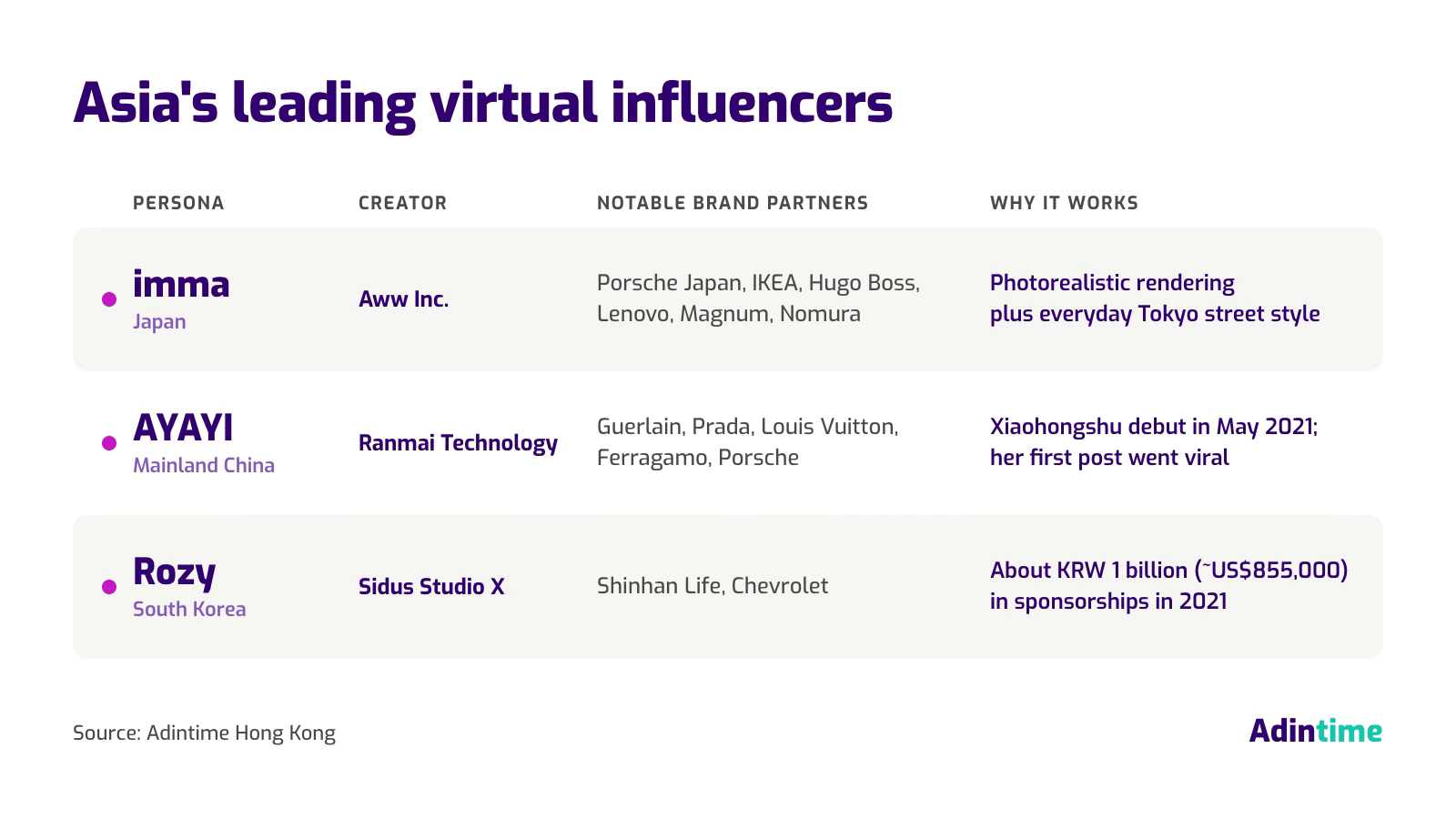
Mainland audiences are already engaged. An iiMedia Research survey reported by Daxue Consulting and Dao Insights found that 63.6% of Chinese netizens followed news and updates about virtual influencers. For Hong Kong businesses, that familiarity sits just across the border, and it travels with the mainland visitors who come to Hong Kong to shop.
Why brands invest in AI generated personas
1. Brand safety and reputation control
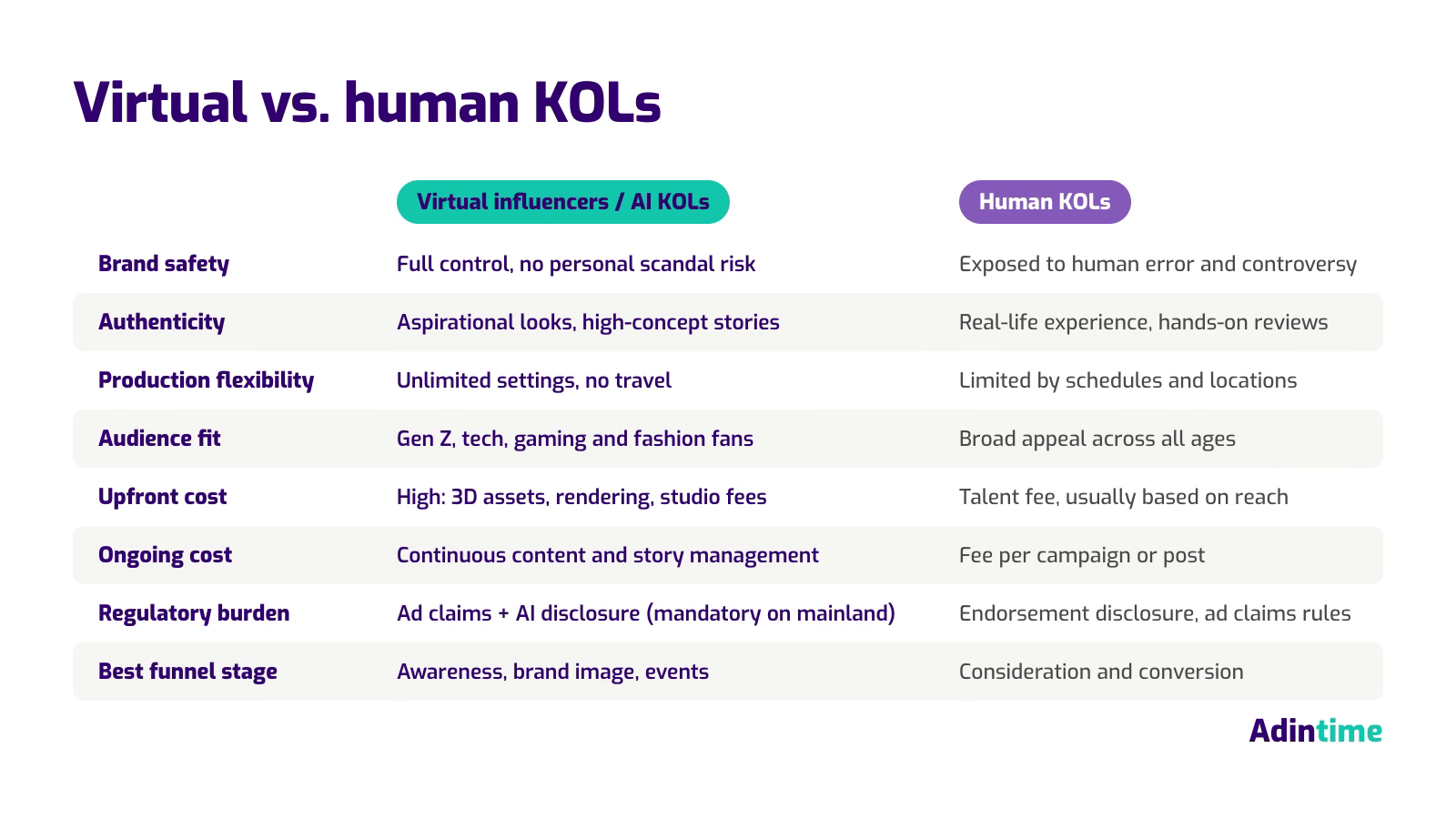
Human influencers bring risks you can’t control, such as personal controversies, legal trouble, unvetted political comments, and lifestyles that clash with the brand. A virtual KOL only does what’s in the brief, which removes the risk of a talent scandal. The risk shifts to execution quality and how the audience reacts instead.
2. Stronger engagement, for now
Novelty and visual polish help these accounts perform well in social platform algorithms. HypeAuditor’s analysis of Instagram data found that virtual influencers had nearly three times the engagement rate of human influencers. Treat this as a historical benchmark rather than a guarantee, engagement tends to settle as audiences get used to synthetic characters, and that makes the quality of the storytelling decisive.
3. Working across borders
A digital character has no visa issues, scheduling conflicts or travel costs. One virtual ambassador can launch a capsule collection in Central, appear at a digital showcase in Shanghai and post localised content in Cantonese, Mandarin, Japanese and English in the same week. When you localise, the language choice still matters. See Cantonese, Mandarin or English: Choosing Your Ad Language in Hong Kong.
4. Market momentum
Grand View Research estimated the global virtual influencer market at around US$6.1 billion in 2024, projected to reach about US$45.9 billion by 2030. The latest edition of the report extends the forecast to US$110 billion by 2033. Asia Pacific is the fastest growing region, and fashion and lifestyle is the largest category of spend.
The Hong Kong strategy: where virtual KOLs fit
In Hong Kong’s mixed media landscape, virtual influencers work best in two scenarios.
1. Reaching the Greater Bay Area and mainland visitors on Xiaohongshu
Hong Kong retail, hospitality and luxury brands compete hard for spending from mainland tourists and Greater Bay Area residents, and much of that competition happens on mainland social platforms. Users on Xiaohongshu and Douyin already see virtual KOLs as familiar cultural figures. An AI persona on Xiaohongshu can link Hong Kong’s polish with mainland digital trends, without complex talent contracts across jurisdictions.
2. Engaging Gen Z and digital communities at home
Younger people in Hong Kong lean heavily towards visual, interactive media on Instagram, TikTok and YouTube. Our ranking of the top social media platforms in Hong Kong and our guide on whether Hong Kong advertisers should consider TikTok cover where this audience spends its time.
Virtual KOLs shouldn’t replace local micro influencers. They work best as the centrepiece of a high concept launch, such as a flagship opening in Causeway Bay, a tech product release or an immersive art event. The most effective model is a hybrid, the virtual character carries the campaign idea, while human creators provide real world demos and social proof. Launching a new brand? The KOL layer is phase two of our first year media playbook for launching a brand in Hong Kong.
Risks, costs and regulation
Virtual influencer marketing isn’t an operational shortcut. Brands considering it need to manage two issues.
1. The authenticity gap and the “uncanny valley”
Audiences happily engage with virtual influencers as art, fiction or cultural symbols. Trust collapses quickly, though, when a virtual persona pretends to have human experiences: reviewing the texture of a skincare cream, describing the taste of a restaurant’s food, or claiming long term health results. Unconvincing executions fall into the “uncanny valley,” where something almost human feels unsettling, and they put people off.
2. High development and maintenance costs
Building a custom CGI influencer, or licensing an established one, is expensive. Photorealistic 3D modelling, motion capture, ongoing post production and narrative direction can easily match or exceed the fees of reputable mid to top tier human KOLs. Low budget shortcuts produce stiff animation and artificial looking graphics that can damage a premium brand.
Generative AI can cut the cost of everyday content around the character. How to Use Generative AI for Ad Creative: Copy, Image and Video shows where it helps and where it doesn’t. Treat the character as a long term asset, not a one off campaign cost. Our advertising budget guide explains how to separate production from media spend.
Virtual vs. human KOLs: a comparison
How to measure a virtual KOL campaign
Judge an AI KOL on more than likes. Track:
- Engagement quality: saves, shares and comment sentiment, not just reactions.
- Branded search and social mentions: does the character create conversations about the brand, not only about itself?
- Earned reach: user generated videos of outdoor or 3D billboard placements.
- Downstream conversion: results from the human creators and paid media running alongside the character.
Advertising Analysis: How to Understand if Your Ads Are Doing Well and Master Big Data to Optimise Ad ROI explain how to set up the measurement framework.
Should your brand use an AI KOL?
Before committing budget to a digital human, run through this checklist.
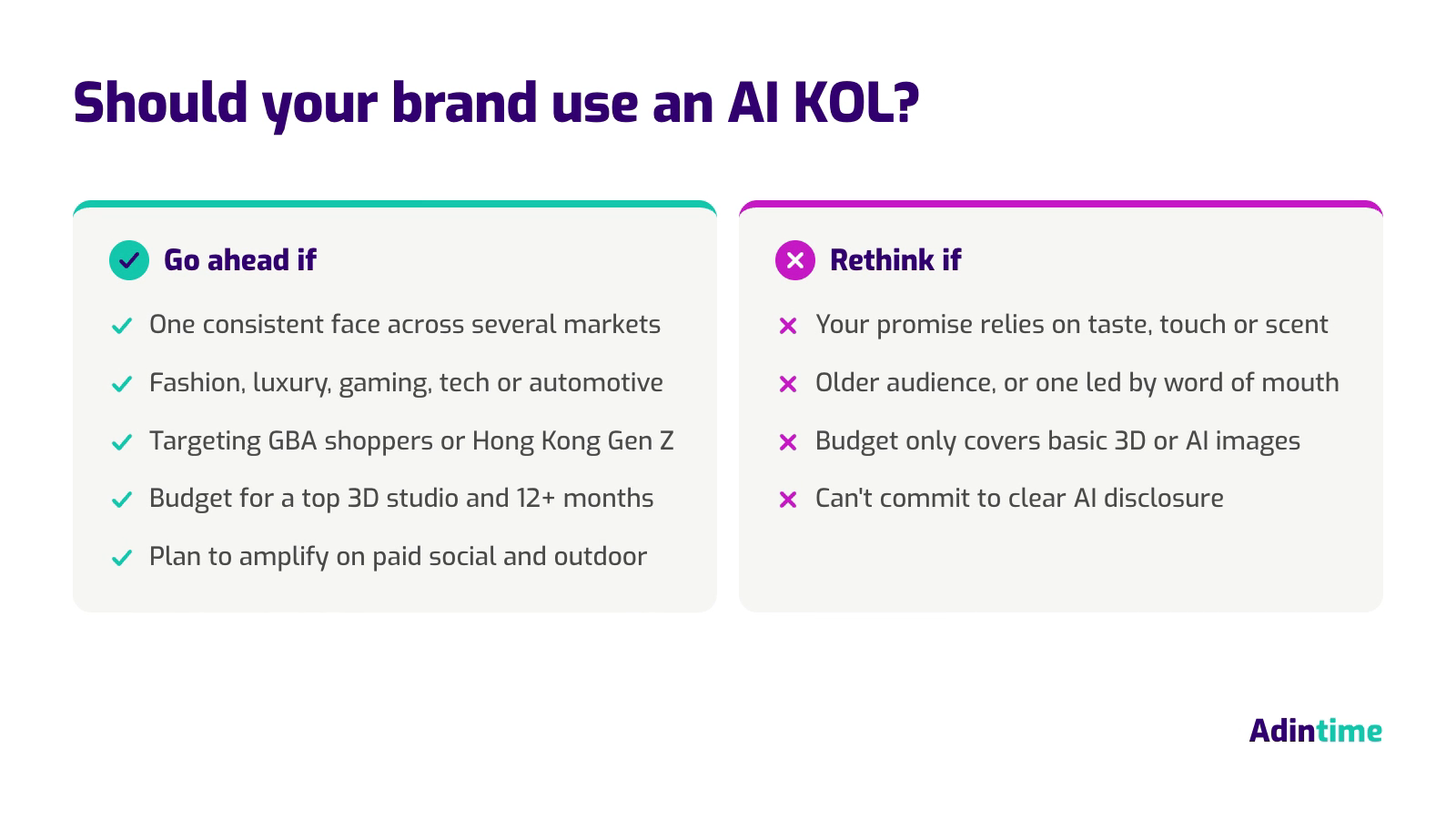
Not sure which side you’re on? Submit a media brief and our team will recommend a creator mix, virtual, human or hybrid, across Hong Kong’s social and outdoor channels. You can also work with our advertising agency in Hong Kong on the full campaign.
FAQ
1. What’s the difference between an AI influencer and a virtual KOL?
The terms are largely interchangeable. In Western markets, “virtual influencer” or “CGI influencer” is most common. In Hong Kong, mainland China and the rest of Asia, the industry usually says “AI KOL”, “virtual idol” or “virtual human/ metahuman”. Strictly speaking, a CGI influencer is designed and scripted by people, while an “AI” influencer may also use generative AI for its images, voice or replies.
2. Do virtual influencers really get higher engagement?
Historically, yes. HypeAuditor’s analysis of Instagram data found virtual influencers had nearly three times the engagement rate of human influencers. Much of that comes from curiosity and the novelty of the visuals, so engagement tends to settle as audiences get used to synthetic characters. Over time, the quality of the storytelling matters more than the novelty.
3. Is virtual influencer marketing legal in Hong Kong?
Yes, but it’s fully covered by existing consumer protection and advertising law. Under the Trade Descriptions Ordinance, every product or service claim made through a virtual character must be accurate and verifiable. Clearly labelling paid partnerships and AI generated content is strongly recommended in Hong Kong, and on mainland platforms AI content labelling is mandatory. See AI in Advertising: Ethics, Deepfakes and Regulation in Hong Kong.
4. How much does a virtual influencer cost?
It depends on the model. Licensing an established persona for a campaign costs about the same as hiring a mid to top tier human KOL. Building a custom photorealistic character means a larger upfront investment in 3D design, motion capture and an ongoing content team. Budget for at least 12 months; a character that disappears after one campaign rarely builds a following.
5. Can a virtual influencer replace human brand ambassadors entirely?
Rarely. The most successful strategies are hybrid. Virtual KOLs lead aspirational visuals, digital events and top of funnel reach, while trusted human creators handle unboxings, real community conversation and conversion.
6. Which platforms work best for AI KOLs in Hong Kong campaigns?
For mainland visitors and Greater Bay Area audiences, Xiaohongshu and Douyin. For local Gen Z, Instagram, TikTok and YouTube. For maximum impact, extend the character to digital outdoor and 3D billboards, where real world visibility adds credibility.





 Virtual Influencers & AI KOLs in Hong Kong: What Brands Should Know
 Launching a Brand in Hong Kong: A First-Year Media Playbook
 Best AI Advertising Tools for Marketers in Hong Kong (2026)
 How to Advertise to Mainland Chinese Visitors in Hong Kong
 Shopping Mall Advertising in Hong Kong: Formats, Footfall and Rates
 Understanding YouTube Advertising Costs in 2025
 The Most Widely-Read Magazine and Newspaper in Hong Kong
 Top Social Media Platforms in Hong Kong 2025 | Usage Trends & Marketing Insights
 OOH /DOOH advertising in Hong Kong: Formats and Rates (2025 Update)
 How much does LinkedIn Advertising Cost? (2025 Update)
